Built to Last, Built to Sell: The Case for a Fairer DSP Exit

DSP owners are asked to build real businesses. They deserve a real path to selling an Amazon DSP.
Most Amazon Delivery Service Partners sign their first agreement believing they are building something real. A business with equity. An asset they can sell one day, hand to a son or daughter, or cash out to fund a retirement they earned the hard way. It is a reasonable belief. It is also, in practice, mostly an illusion.
Here is the uncomfortable truth: you can pour years of capital, sweat, and reinvested profit into a DSP and still discover, when you finally want out, that you do not actually control the one thing that defines ownership — the right to sell.
That problem starts with a simple fact. A DSP transfer is not a deal between a willing seller and a willing buyer. It is a deal between a seller, a buyer, and Amazon, which retains the right to approve or reject both. You can find a buyer. You can agree on a price. You can shake hands. And the whole thing can still die in review, with little visibility into the criteria or the timeline. When the company that controls your contract also controls your exit, the word “ownership” starts to lose its meaning.
The valuation problem runs just as deep. Business value comes from reliable future earnings, and the first thing any buyer or lender asks is where that money comes from. A DSP has one answer: Amazon. Every route, every package, every dollar flows through a single relationship that Amazon can modify or decline to renew. There is no second customer to cushion the blow. That concentration is not a theoretical risk — it is the first red flag a buyer’s advisor flags, and it gets priced straight into a lower number.
Then there is the contract itself. DSP agreements were not written to change hands. Owners operate as independent contractors through their own LLCs, yet their agreements lack the transfer rights and renewal protections that a real franchise relationship would carry. DEFT’s lead legal counsel, Peter R. Silverman of Shumaker, Loop & Kendrick, LLP, has publicly flagged these vulnerabilities — the missing renewal rights, the unilateral changes to operational terms. So attorneys on both sides end up improvising around language never meant to support a sale. Every workaround adds cost, delay, and risk.
Financing makes it harder still. For most small businesses, an SBA loan lets a qualified buyer step in without paying all cash. DSP buyers rarely get that luxury. A lender sees one customer and a short-term, non-renewable contract, and the underwriting math turns cautious fast. The buyers who could run a DSP well often can’t get the deal financed at all.
Insurance follows the business like a shadow. Fleets of vans, employed drivers, and high daily volume generate claims, and that history transfers to the buyer along with everything else. A clean operation can still carry a record that spikes premiums or makes coverage hard to secure. Buyers will request the full history during due diligence, and what they find becomes either a dealbreaker or a discount. Remember, 78% of owners in DEFT’s survey rank auto insurance among their top three urgent issues. This is not a small detail. It is a lever.
The fleet looks like real value until you try to sell it. Many DSP vans — Amazon-branded vehicles, Rivian EDVs — are leased, not owned, and branded units can’t simply be resold or repurposed outside the program. Their worth is tied to the contract continuing. A buyer isn’t acquiring independent assets. They’re buying access that evaporates the moment Amazon walks away.
And the margins? They no longer support a strong price. Valuations rest on a multiple of earnings, and when earnings are thin or negative, the math collapses. More than 95% of DSP owners tell DEFT their net margins are far lower than when they joined. During Peak 2025 — the busiest, highest-revenue stretch of the year — over half still reported lower profits or margins. When your best season ends in compression, a high-value exit becomes a fantasy.
Source: DEFT Survey, June 2026 Respondents were asked: “If given the opportunity to sell your DSP, how attractive would each of the following offers be for you to walk away? Assume the amount is free and clear (i.e., net proceeds).”
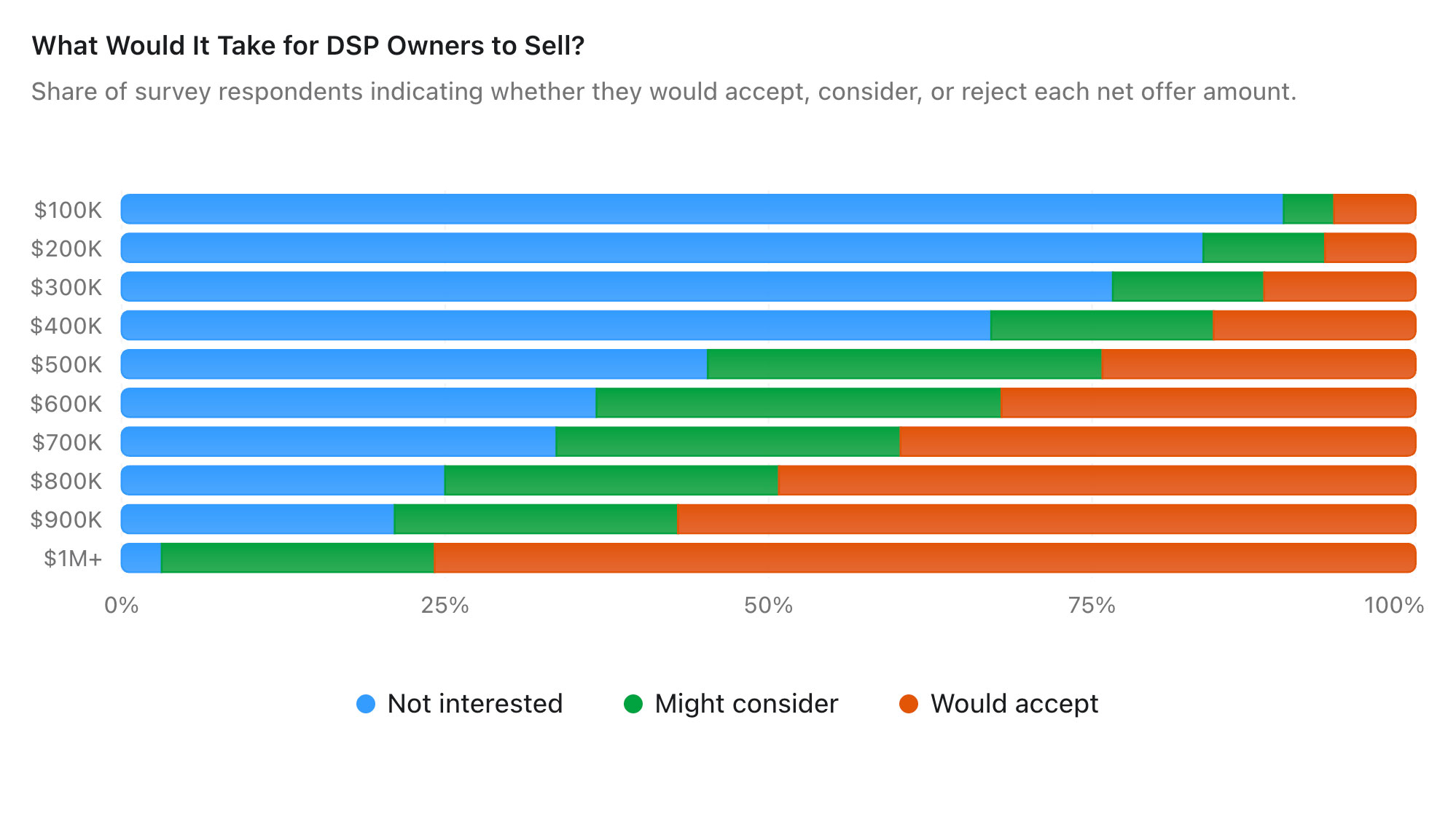
Even a perfect buyer can’t fix the market around them. The pool of people who understand the model, accept the risk, hold the capital, and can clear Amazon’s approval is tiny. There is no broker network, no resale infrastructure, no organized way to match sellers with qualified buyers. That thin, quiet market favors buyers every time. And because a DSP’s finances can swing in a single quarter — insurance, repairs, scorecard shifts — a deal built on last quarter’s numbers may not survive the next statement.
Stack all of this together and you reach one conclusion: DSP owners have been denied the most basic right of ownership — a real way out. What looks like a business starts to feel like a contract-bound job without the protections either status should provide.
DEFT has proposed something neither radical nor unreasonable: let owners sell to reasonably qualified buyers. Amazon keeps its operational standards and its right to vet buyers. What it gives up is the unchecked power to trap owners in a contract they cannot leave. A real transfer market would widen the buyer pool, lift valuations, reward long-term investment, and give thousands of owners a genuine path to retirement or succession.
You built it. You should be able to sell it. Add your voice at deft-us.com and help make that the standard. Join Today