Every Program Change Has a Price: Who Pays for Amazon’s Moving Targets?
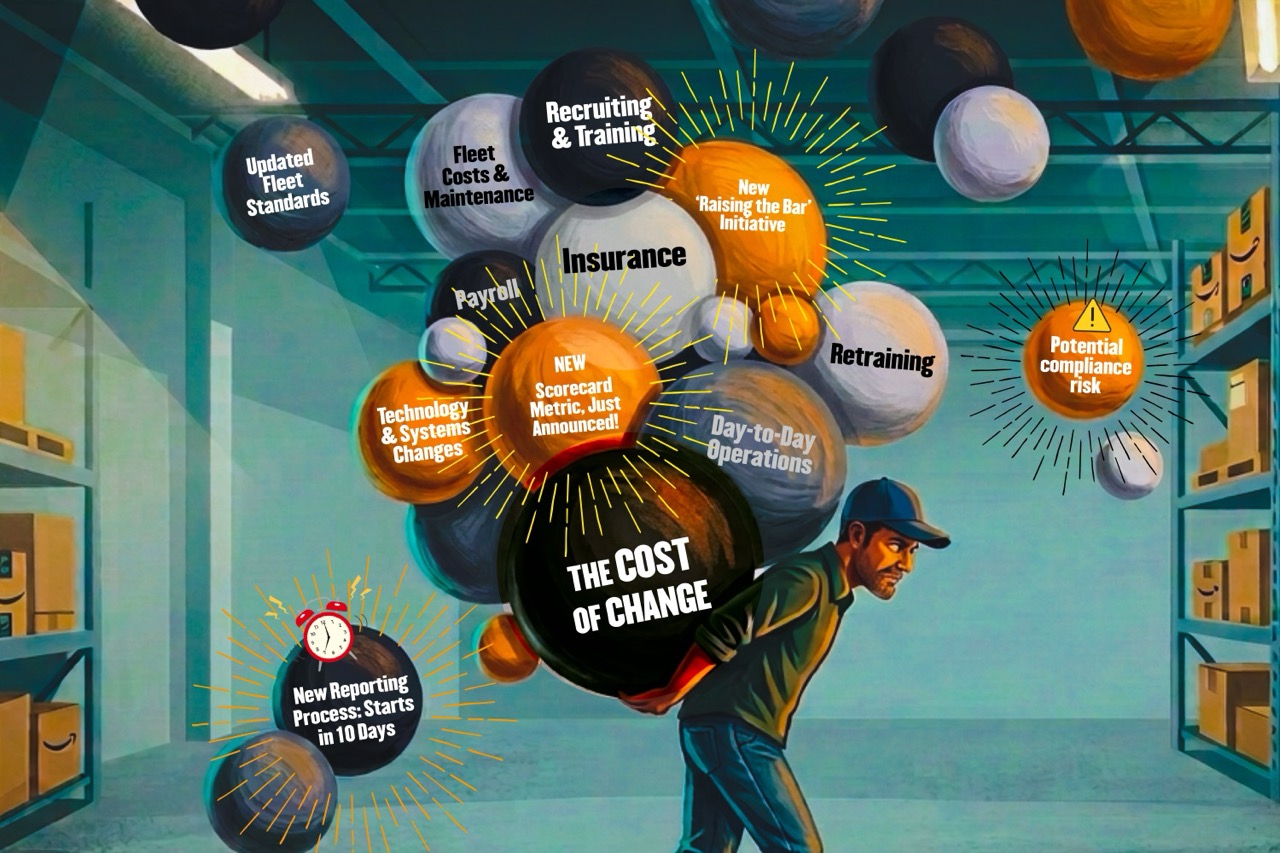
When a program requirement changes, the announcement is rarely the hardest part. The hardest part is what comes next: figuring out what the change actually costs, who absorbs that cost, and how quickly it needs to happen.
For DSP owners, that calculation happens constantly—and almost always without enough time, information, or support to do it well.
The Hidden Price Tag on Every New Requirement
Program changes arrive in different forms. A new metric. A revised reporting process. Updated fleet standards. A retraining requirement. A “raising the bar” initiative. Individually, each one may seem manageable. Collectively, they represent a significant and recurring drain on DSP time, payroll, and operating resources.
Consider what a single operational change can actually require:
- Management time spent reading, interpreting, and planning a response
- Staff time for retraining, process updates, or new documentation
- Technology or systems changes to track new requirements
- Payroll impact from additional administrative responsibilities
- Potential compliance risk during the transition period, before everything is fully in place
None of these costs show up in a rate card adjustment. They show up in owner hours, team capacity, and the bottom line—quietly, and often without acknowledgment.
Planning Is Not Possible Without Predictability
DSP owners are expected to manage labor responsibly, operate within budget, and maintain consistent service quality. That is a reasonable expectation. But it becomes significantly harder when the rules of the program shift without adequate notice or a clear explanation of what the change will require operationally.
When a new requirement is announced with a short implementation window, owners face an uncomfortable choice: move fast and risk getting it wrong, or take the time to do it right and risk falling behind. Neither option reflects a failure of the DSP. It reflects the absence of a process that respects how much operational change actually costs.
According to DEFT survey data, roughly 90% of DSP owners report that their workload has increased significantly compared to prior periods—and administrative burden consistently ranks among the most cited contributors. That burden does not emerge from thin air. Much of it is the accumulated weight of requirements that changed faster than the support structure around them.
A Reasonable Path Forward
DEFT is not advocating for a program that never evolves. Change is a normal part of any business relationship, and many program updates are genuinely intended to improve outcomes for everyone. What we are asking for is a process that treats operational impact as a serious consideration before implementation—not an afterthought.
Specifically, we believe major program changes should include:
- Advance notice sufficient for owners to plan staffing, training, and budget adjustments
- A clear operational summary describing what will be required and by when
- An honest cost impact review, including the realistic time and resource burden for a typical DSP
- An opportunity for DSP input before finalization, particularly when changes affect day-to-day operations
- Appropriate compensation or support when new requirements create costs that fall outside existing rate structures
This is not an unusual ask. In most business partnerships, significant operational changes come with lead time, documentation, and a discussion about shared responsibility. That same standard should apply here.
Change Can Work—When It’s Done Well
The goal is not to slow down program improvement. The goal is to make sure that improvement is shared improvement—that when the program gets better, DSP owners are positioned to implement those changes without absorbing unacknowledged costs or operational disruption.
A process that includes notice, input, and honest cost analysis does not just protect DSPs. It produces better outcomes for the network. Changes that are well-planned and adequately resourced are more likely to be implemented correctly, consistently, and sustainably.
We believe that is a goal worth working toward together.